We’re eager to bring your sound ideas to life!

E-mail Us Cary@SoundBrandingIdeas.com

w

Chat With Us Below
We're always here!

Call Us Today!
866-826-6692

Express Your Brand’s Personality Through Sound: A Practical Sonic Branding Strategy

Sonic branding—also called audio branding—is the intentional use of sound to convey a brand’s personality. It works by mapping musical and vocal features to clear brand traits that drive emotional connection and improve recall. This guide shows how sonic logos, jingles, and voiceovers combine into a consistent brand sound identity, why those audio cues shape perception, and how to build measurable audio assets that scale across channels. Many teams struggle to translate visual identities into sound because audio requires specific rules for consistency, adaptability, and testing. This article lays out practical frameworks, production steps, and measurement tactics to close that gap. You’ll learn which core audio elements matter, how to run a structured audio branding process, which services suit different campaign goals, and how to evaluate results with concrete KPIs. Throughout, we use terms like sonic personality, brand sound identity, and audio brand architecture to tie creative choices—melody, timbre, tempo, and voice casting—to measurable business outcomes.

Key Takeaways

  • Sonic branding uses sound to communicate brand personality and strengthen emotional bonds with audiences.
  • Sonic logos, jingles, and voiceovers each play distinct roles in building a recognizable audio identity.
  • A cohesive brand sound blends melody, harmony, rhythm, instrumentation, and voice tone for consistent cross-channel use.
  • Sound shapes perception by engaging auditory memory and emotion, improving recall and trust.
  • An effective audio branding process follows discovery, creative briefing, composition, production, testing, and governance.
  • Tools like adjective matrices and archetype mapping translate brand traits into actionable sonic characteristics.
  • Pick services based on goals: sonic logos accelerate recognition; jingles boost memorability in high-frequency campaigns.
  • Emerging trends include AI-driven personalization, immersive spatial audio, and multisensory brand experiences.
  • Measure impact with recognition tests, emotional-response metrics, and commercial attribution to validate outcomes.

What Is Sonic Branding and How Does It Define Brand Personality?

Sonic branding is the craft of designing a consistent audio identity—short audio cues, musical themes, and vocal styles—that signals a brand’s personality. Humans naturally link timbre, tempo, and melodic shape to emotions and behaviors, which speeds recognition and strengthens memory. By selecting a sonic palette—instrumentation, harmony, tempo, and voice—you translate adjectives like trustworthy, playful, or luxury into reproducible audio choices that steer perception. Unlike visual identity, sound unfolds over time and taps auditory memory systems, making it especially potent in audio-first or multimodal touchpoints. For early credibility, Sound Branding Ideas offers services such as jingle creation, slogan writing, and custom voiceovers produced by composers and vocal talent; these offerings show how strategy becomes production while fitting into a broader audio plan. Knowing these relationships helps teams decide which sonic assets to commission and how to govern their use across channels.

How Do Sonic Logos, Jingles, and Voiceovers Convey Brand Identity?

Sonic logos, jingles, and voiceovers each signal identity in different ways: a sonic logo is a brief audio mnemonic for instant recognition; a jingle embeds a name or slogan into melody for lasting memorability; a voiceover carries narrative tone and clarity across messaging. Musical choices—interval movement, rhythmic placement, and instrumentation—shape perceived traits: minor keys and slower tempos often suggest seriousness or heritage, while bright timbres and syncopation imply playfulness and energy. Voiceovers add a human dimension: timbre, cadence, and accent affect trust, approachability, and authority. Use sonic logos at the start or end of ads and app events, deploy jingles in high-repetition campaigns to lock in recall, and reserve voiceovers for storytelling and instructions where clarity and persona matter.

What Are the Key Components of a Brand Sound Identity?

A coherent brand sound identity bundles melody, harmony, rhythm, instrumentation, voice tone, and usage guidelines into a governed sonic palette that stays consistent while adapting to context. These components act as parts of an audio system: motifs provide mnemonic hooks; harmony and arrangement set emotional color; rhythm and tempo determine energy; instrumentation signals category and setting; voice guidelines define persona and intelligibility. The quick reference table below helps teams compare elements and decide priorities for briefs and production handoffs.

Audio ElementKey AttributeTypical Example/Value
Sonic LogoDuration2–4 seconds
JingleLyrics + Melody15–30 seconds with a name hook
VoiceoverVoice ToneWarm baritone, bright female, or neutral conversational tone
InstrumentationTextureAcoustic guitar for warmth; synth pads for modernity

This compact reference clarifies creative decisions and helps teams align deliverables before production starts. Using a shared table prevents ad-hoc choices that erode consistency and smooths handoffs between strategy and production.

How Does Sound Create an Emotional Connection with Your Audience?

Sound forges emotional connection by activating auditory pathways tied to memory and affective brain regions. Timbre, tempo, and melodic contour set mood and support associative learning, which anchors brand messages to emotional states. Short audio motifs often stick in auditory memory better than visuals, so well-crafted cues become quick recall shortcuts across environments. The practical work is mapping desired emotional outcomes—comfort, urgency, joy—to musical features and validating those choices with audience testing. When deployed consistently across touchpoints, emotionally aligned audio increases authenticity and makes brands feel more familiar—and therefore more trustworthy.

What Is the Science Behind Sound Influencing Brand Perception?

Research shows short audio cues produce rapid neural responses linked to recognition and emotion, and that features like tempo and timbre consistently align with affective labels such as excitement or calm. Conditioning and associative learning explain how repeating a sonic motif with a brand experience creates automatic recognition and positive valence. For practitioners, this means designing clear, repeatable contours and testing them with target audiences to confirm the intended emotional mapping. Cross-modal reinforcement—pairing congruent visuals and sound—also amplifies recall and can lift purchase intent.

How Does Consistent Audio Branding Build Trust and Recognition?

Consistency lowers cognitive load and builds familiarity, which over time strengthens trust and recognition across ads, apps, retail, and customer service. Governance—usage rules, approved variants, and channel-specific adaptations—keeps the sonic identity coherent while allowing necessary flexibility. Define where the full jingle plays versus where a micro sonic logo is appropriate, maintain a voice talent pool, and use mixing presets to preserve timbral consistency. These governance steps reduce accidental brand drift and support cumulative recognition.

How to Create Your Brand Sound: Step-by-Step Audio Branding Process
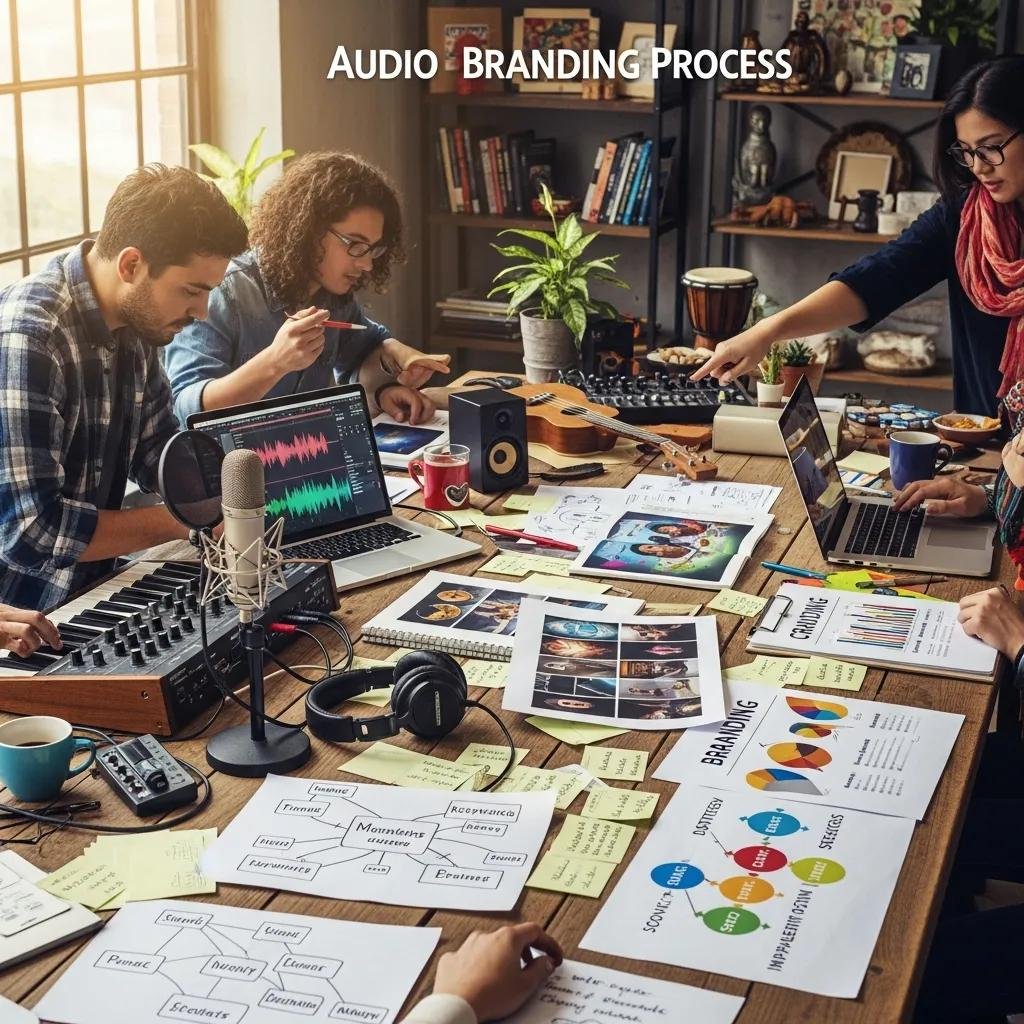
A reliable audio branding process starts with discovery, maps adjectives to sonic options, moves into a creative brief and composition, proceeds through production and testing, and finishes with deployment and governance. This stepwise pipeline ties strategic intent to concrete deliverables and testing checkpoints, ensuring assets align with brand strategy and audience response. Use the checklist below during planning and procurement.

Follow these steps to build a sound identity:

  • Discovery: Map brand adjectives, audience contexts, and the competitive audio landscape.
  • Creative Brief: Define the sonic palette, duration targets, and asset usage rules.
  • Composition & Casting: Develop motifs, choose instrumentation, and cast voice talent.
  • Production & Mix: Record, arrange, and master assets for platform-specific delivery.
  • Testing & Governance: Run recognition/A–B tests, finalize guidelines, and deploy.

These steps create a repeatable workflow that keeps creative choices tied to business objectives and measurable outcomes. Teams that follow this pipeline reduce rework and raise the odds that sonic assets will perform as intended.

What Frameworks Help Define Your Brand Voice and Sonic Personality?

Frameworks turn abstract adjectives into concrete audio directions with exercises like adjective matrices, archetype-to-sound mapping, and audience-sound fit workshops. An adjective matrix lets teams match personality words (bold, warm, playful) to musical features (tempo, mode, instrumentation), generating direct production guidance. Archetype mapping pairs brand archetypes (caregiver, rebel, creator) with sonic heuristics to simplify casting and arrangement choices. Audience-fit sessions validate these mappings with representative listeners to ensure cultural and contextual relevance. Use these frameworks in collaborative workshops to produce a one-page sound brief for composers and producers.

How Are Custom Jingles and Voiceovers Developed to Match Brand Values?

Custom jingles and voiceovers follow a creative pipeline: brief → sketch → refine → record → mix → test. Typical roles include strategist, composer, lyricist, voice director, and producer; decisions at each stage—tempo, key, vocal style, locale—must reflect mapped brand values and audience expectations. Casting aligns vocal timbre to persona; scripts prioritize brevity and clarity for auditory retention; production ensures mixes translate across devices. Sound Branding Ideas combines composition, lyric writing, and voice casting with professional artists and producers to deliver original audio and lyrics that meet strategic intent while remaining adaptable for campaigns or rebrands.

Which Audio Branding Services Best Express Your Brand’s Personality?

Different services address needs across the customer journey: sonic logos for immediate recognition, jingles for memorability in high-repetition campaigns, and custom voiceovers for clear, persona-driven messaging. The right mix depends on campaign goals, touchpoint frequency, and listening environments—a direct-response spot may favor a strong voiceover plus a short sonic tag, while brand building benefits from a memorable jingle paired with a sonic logo. The service comparison below helps decision-makers evaluate deliverables and outcomes.

ServiceDeliverablesBusiness Benefit
Sonic Logo2–4 sec motif + variantsQuicker auditory recognition
Jingle CreatingMelody + Lyrics + MixStronger recall and campaign memorability
Custom VoiceoversScripted recordings + editsClearer messaging and a consistent persona

This comparison clarifies what each service delivers and the outcomes brands can expect, helping procurement prioritize investments and plan timelines.

What Are the Benefits of Professional Jingle Creating and Slogan Writing?

Professional jingles and concise slogans turn brand messages into musical hooks that boost recall and emotional impact, making campaigns more memorable and shareable. Melodic hooks matched with tight lyrical phrasing create associative links that raise top-of-mind awareness and ad effectiveness under repeated exposure. Well-crafted jingles also adapt across channels—short tags for social, extended cuts for broadcast—while lyric-driven slogans support verbal recall in noisy or low-attention contexts. For tailored work, Sound Branding Ideas provides custom jingles and slogans from composers and lyricists who prioritize originality and adaptability for evolving campaigns.

How Do Custom Voiceovers Enhance Brand Messaging?

Custom voiceovers sharpen clarity, tone, and persona across audio and video by selecting voice characteristics that align with brand traits and directing performances to match emotional intent. Casting choices—age, gender, timbre, accent—should reflect target-audience expectations and brand positioning to avoid dissonance. Professional direction ensures pacing, enunciation, and emphasis support conversion and comprehension, especially in ads and IVR systems. Including accessibility and localization during voice production broadens reach and signals inclusivity while keeping persona consistent across regions.

What Are the Latest Trends and Future Directions in Sonic Branding?

Key trends now and ahead include AI-enabled personalization, immersive spatial audio for AR/VR, human-plus-AI workflows, and short-form adaptations for new platforms. These shifts affect how brands scale audio assets and demand updated governance to protect authenticity while leveraging automation. Practical next steps: build modular sonic assets, set ethical AI guardrails, and invest in testing frameworks that capture real-world performance across devices and contexts. Brands that design flexible architectures can personalize experiences without losing the core identity that drives recognition.

How Is AI Transforming Personalized Sound Experiences?

AI enables adaptive music and voice variants that personalize audio in real time—matching mood, location, or user data—and speeds iteration and localization. Quality and ethical concerns call for hybrid workflows where composers and voice directors vet AI outputs to ensure originality and brand fit. Recommended guardrails include clear policies on synthetic voice use, human review checkpoints, and preserving creative control over lyrics and audio trademarks. Used responsibly, AI broadens creative possibilities and shortens production cycles for tailored sound experiences.

What Role Do Immersive Soundscapes and Multi-Sensory Branding Play?

Immersive soundscapes and multisensory design use spatial audio, tactile feedback, and aligned visuals to create standout brand moments in retail, events, and AR/VR. Design principles focus on narrative continuity, spatial balance, and interaction cues that guide attention without overwhelming the experience. Pairing sound with lighting, scent, and texture strengthens associative networks and extends memory retention. Measure these experiences with experiential KPIs—dwell time, qualitative sentiment, and attribution to longer-term recognition metrics.

How Can You Measure the Effectiveness of Your Brand’s Sound Identity?

Measuring a sound identity requires recognition studies, A/B audio tests, emotional-response metrics, and commercial attribution to link audio investments to business outcomes. Combine explicit recall tests with implicit neuro/biometric measures and digital attribution to connect audio variants to engagement or conversion lifts. Structure measurement iteratively: pilot motifs, test broadly, refine from data, and roll out with governance. Sound Branding Ideas measures effectiveness by pairing recognition tests with campaign analytics and case studies to demonstrate awareness lift and improved recognition.

The table below maps common metrics to methods and expected outcomes to guide executive decisions.

MetricMeasurement MethodTypical Result
Recognition LiftA/B audio tests, recall studies+X% in auditory recognition
Emotional ResponseImplicit tests, biometric or surveyIncreased positive valence
AttributionDigital analytics, conversion liftHigher engagement and CTR

Use this metric-method map to choose which studies to run first based on budget and stakeholder requirements. Consistent measurement makes sonic branding a defensible investment rather than an artistic guess.

What Key Performance Indicators Track Sonic Branding Success?

KPIs should include recognition/recall rates, emotional affinity scores, attribution tied to conversions, and consistency measures across touchpoints. Benchmarks vary by industry and campaign scope, but tracking pre/post changes shows the real impact of audio identity work. Combine quantitative A/B tests for attribution with qualitative interviews for context. Regular measurement cycles let you refine governance and asset variants to maximize both recognition and commercial impact.

How Do Case Studies Demonstrate Emotional and Recognition Impact?

A strong case study lays out the context (objectives and audience), the audio solution (assets and rationale), the methodology (tests and metrics), and the results (recognition lift, emotional measures, and business outcomes). Include before/after metrics, sample audio, and testing protocols to make findings credible and actionable. Presenting case studies this way builds stakeholder confidence and clarifies ROI paths for future audio investments. Brands can request anonymized portfolio examples and measurement summaries during procurement to validate approaches.

Frequently Asked Questions

1. How does sonic branding differ from traditional branding?

Sonic branding centers on audio to create identity, while traditional branding often focuses on visual elements like logos and color. Sound can evoke emotion and improve memory retention in ways visuals can’t, offering a unique, persistent connection. Because audio plays over time and often in the background, it can leave a lasting impression that complements visual branding and deepens the overall brand experience.

2. Can sonic branding improve customer loyalty?

Yes. Effective sonic branding builds a recognizable audio identity that resonates emotionally with audiences. When people identify a brand by its sound—a jingle or a sonic logo—they often form stronger affinities. That emotional connection can improve experience, increase engagement, and encourage repeat interactions across platforms.

3. What role does sound play in consumer decision-making?

Sound influences decisions by shaping emotion and associations—background music and specific audio cues can alter perceptions and boost engagement. When brands use sonic elements thoughtfully, they set a mood that supports purchasing decisions. In retail or advertising settings, the auditory environment can meaningfully steer customer behavior.

4. How can businesses measure the impact of their sonic branding?

Measure impact with recognition surveys, emotional-response tests, and sales or engagement data. A/B testing different audio elements reveals consumer reactions, while recall studies show effectiveness. Tracking engagement and conversion changes after audio campaigns helps quantify ROI for sonic branding investments.

5. What challenges might brands face when implementing sonic branding?

Challenges include maintaining consistency across platforms, aligning audio with brand values, and meeting diverse audience preferences. Building a coherent sonic identity requires testing and iteration. Creative interpretations must be balanced against business goals, which can complicate production and strategy without clear governance.

6. Are there specific industries that benefit more from sonic branding?

While all industries can use sonic branding, retail, entertainment, and technology often see outsized benefits. Retailers shape the shopping atmosphere; entertainment brands heighten engagement; tech companies use sound to distinguish products. That said, well-applied audio can enhance brand experience across sectors.

7. What future trends are emerging in sonic branding?

Trends include AI-driven personalized audio, spatial audio for immersive experiences, and integrated multisensory branding. As platforms evolve, adapting audio to new formats and contexts will be increasingly important for creating engaging, memorable interactions.

Conclusion

Sonic branding is a powerful way to express your brand’s identity through audio elements that resonate with people. Consistent soundscapes, jingles, and voiceovers boost recognition and build trust. If you’re ready to elevate your brand, explore customized audio solutions that reflect your unique personality—and start creating a memorable audio identity today.