We’re eager to bring your sound ideas to life!

E-mail Us Cary@SoundBrandingIdeas.com

w

Chat With Us Below
We're always here!

Call Us Today!
866-826-6692

Smart Solutions for Reducing Office Noise: Boost Productivity with Effective Noise Control

Office noise can disrupt focus, increase stress, and lower productivity. Tackling this issue involves both physical acoustic solutions and smart audio strategies to manage reverberation, sound transmission, and speech privacy. This guide explores how acoustic panels, ceiling baffles, sound-absorbing furniture, and engineered audio — like sound masking and curated ambient soundscapes — work together to enhance concentration and privacy in open offices. You’ll discover practical tips on selecting materials (NRC, STC), placing absorptive elements, deploying sound masking systems, and understanding OSHA noise regulations. With practical lists, comparison tables, and checklists, facilities teams and designers can prioritize actions for tangible improvements. We also delve into office acoustics design, soundproofing strategies, and audio environment optimization to support well-being and productivity. Later sections highlight how creative audio providers can enhance engineering controls through unique ambient soundscapes and masking designs to create a cohesive acoustic environment.

What Are the Best Acoustic Treatments for Reducing Workplace Noise?

Acoustic treatments are engineered solutions that reduce reverberation and manage sound transmission to improve speech clarity and minimize distractions. They work by adding absorptive or diffusive surfaces and interrupting direct sound paths. The process is simple: sound absorption reduces reflected energy and reverberation time, while blocking materials increase transmission loss between areas, enhancing speech privacy and reducing perceived loudness. Key metrics for evaluating products include NRC (Noise Reduction Coefficient) for absorption and STC (Sound Transmission Class) for blocking; understanding these helps prioritize treatments for open-plan areas versus enclosed meeting rooms. Solutions range from lightweight acoustic wall panels for speech clarity to flooring and furniture choices that control impact noise. Facilities managers should start with low-cost absorptive fixes before considering major construction.

Here’s a quick list of top solutions for most workplaces to help you prioritize noticeable acoustic improvements.

  • Wall-mounted acoustic panels: Absorb mid- to high-frequency sound to reduce echo and improve speech clarity near workstations.
  • Ceiling baffles and clouds: Cut reverberation across open-plan zones and provide distributed absorption overhead.
  • Acoustic partitions and screens: Create local speech privacy and reduce direct sound pathways between desks.
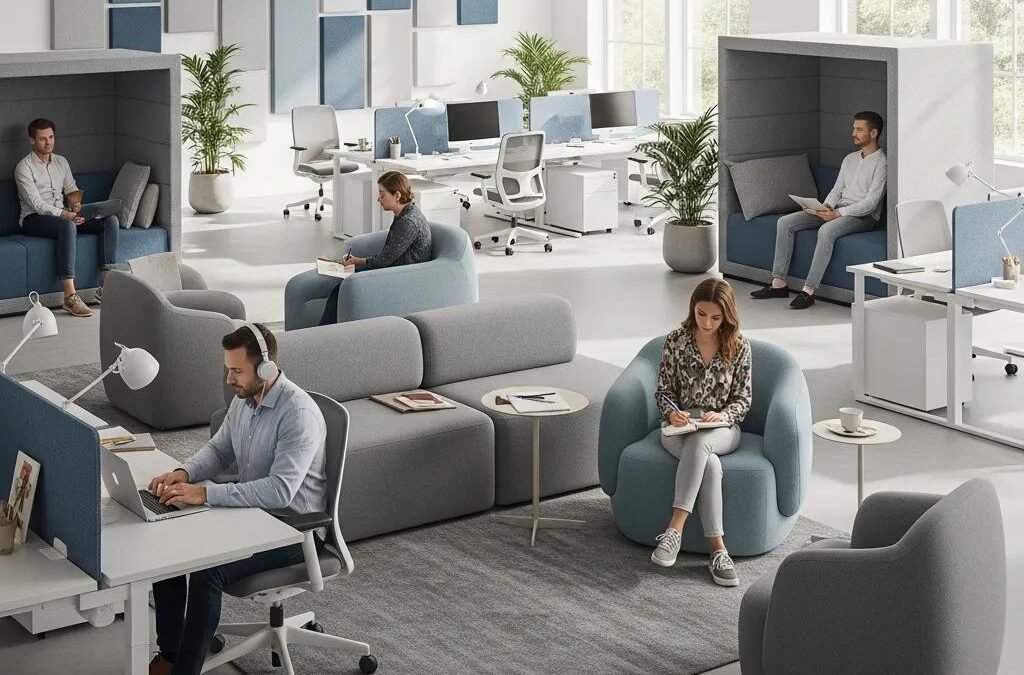
  • Sound-absorbing furniture and booths: Form quiet micro-zones for calls and focused work without structural changes.
  • Flooring and underlayment choices: Reduce impact noise and mechanical transmission from footsteps and equipment.

These five interventions create a layered approach: start by reducing reverberation with absorbers, then add targeted partitions, and finally address transmission through flooring or construction. Understanding product properties helps decide which layers to apply next.

This table compares common acoustic materials by absorption performance and typical office use to guide selection and budgeting.

Material / ProductCharacteristicTypical Use-Case
PET felt wall panelsNRC ~0.40–0.80 depending on thicknessVisual-friendly wall absorption in open-plan and corridors
Mineral wool panelsNRC ~0.60–0.95High-performance ceiling or wall absorption in meeting rooms
Ceiling baffles (fabric-wrapped)Distributed absorption reduces RT60Open-plan overhead treatment to lower overall reverberation
Upholstered acoustic furnitureLocal absorption with furniture functionPhone/breakout booths and collaboration hubs

This comparison clarifies the trade-offs among aesthetics, installation complexity, and absorptive performance, enabling teams to select materials that meet both acoustic goals and design constraints.

How Do Acoustic Panels and Baffles Enhance Office Acoustics?
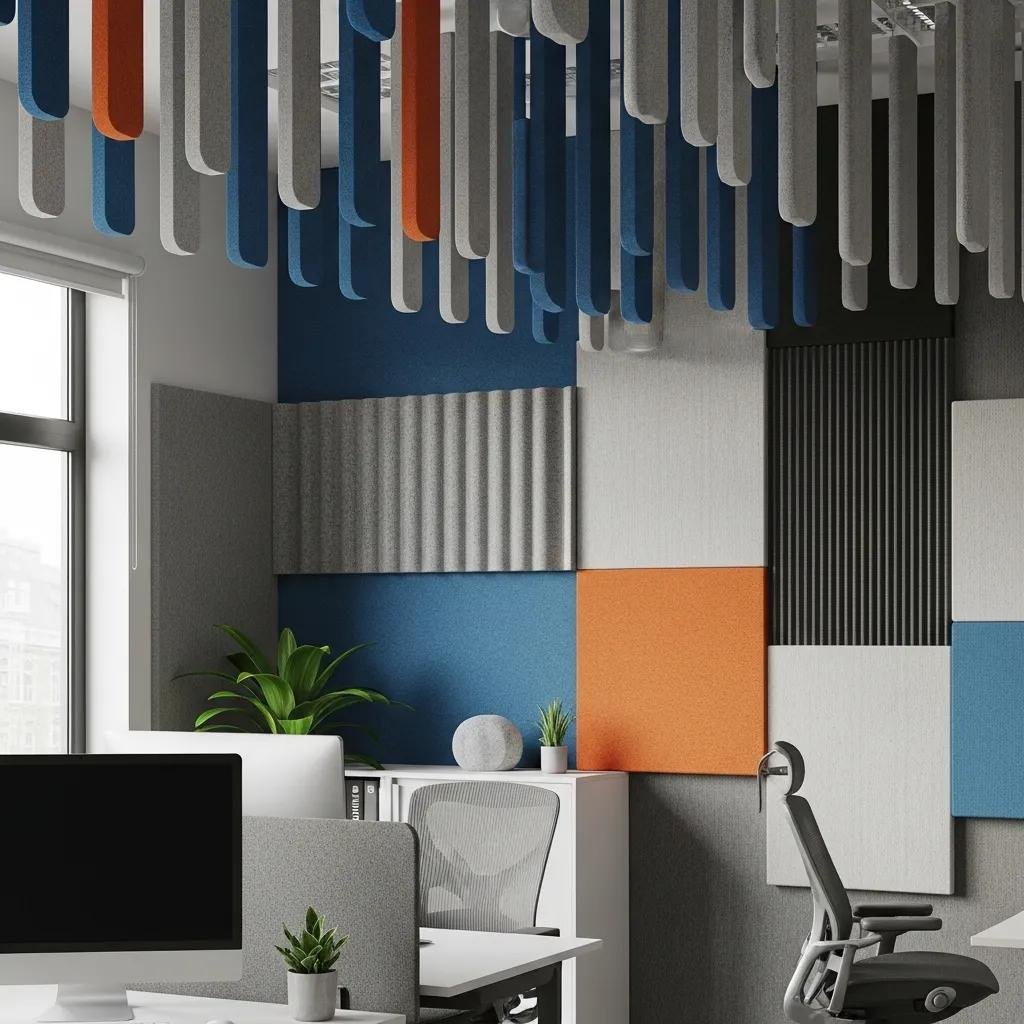
Acoustic panels and baffles enhance office acoustics by absorbing reflected sound energy, thereby reducing reverberation time and improving speech intelligibility. Absorption coefficients measure their effectiveness. Panels typically target mid- to high-frequency energy, where voice intelligibility is most affected, while baffles and clouds provide overhead coverage that interrupts long reflection paths in open spaces. Proper placement follows simple rules: prioritize ceiling clusters above workstations, treat reflective sidewalls near conversational areas, and distribute panels rather than concentrating them to avoid dead-sounding spots. Visual integration is possible through color, pattern, and modular layouts that align with interior design goals while maintaining acoustic performance. Understanding absorption performance and placement ensures panels convert acoustic problems into measurable improvements in concentration and perceived privacy.

What Are the Benefits of Sound-Absorbing Furniture and Flooring?

Sound-absorbing furniture and flooring reduce local noise sources and create quieter micro-environments by combining functional design with absorptive materials. This approach lowers direct reflections and impact noise while preserving flexible workspace layouts. Upholstered booths, acoustic lounges, and desk screens use soft surfaces and internal absorbers to trap mid-frequency energy near occupants, which decreases distraction during calls and focused tasks. Flooring choices such as carpet or resilient underlayments mitigate footfall and equipment vibration transmission that hard floors amplify, improving overall ambient levels. Consider maintenance, hygiene, and lifecycle costs when selecting absorptive furnishings, and weigh ROI from productivity gains against replacement and cleaning budgets. Implementing these softer interventions often delivers rapid perceptual benefits without structural changes, making them attractive first steps in workplace noise control solutions.

How Can Sound Masking Systems Enhance Speech Privacy and Focus in Offices?
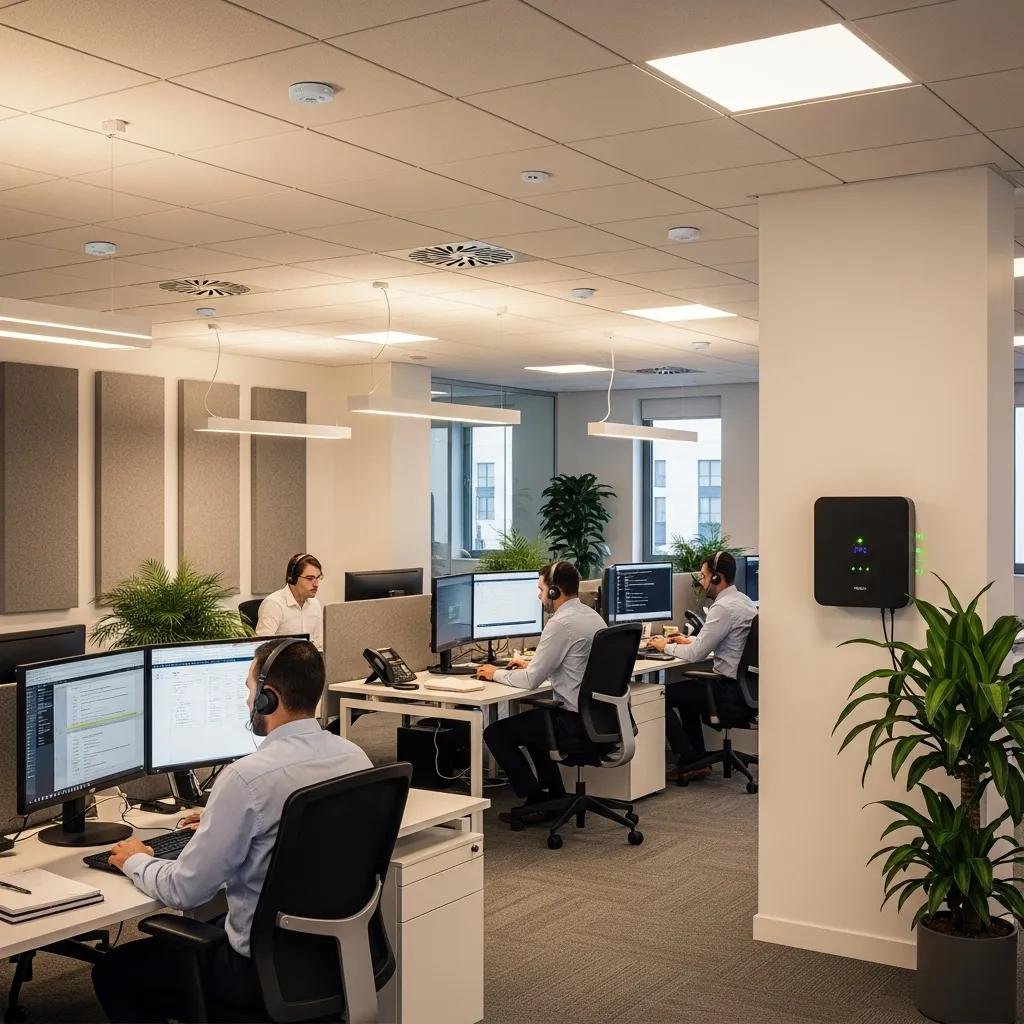
Sound masking systems enhance speech privacy and focus by adding a controlled, unobtrusive background sound that reduces the intelligibility of nearby speech. The system raises the ambient level just enough to mask conversational frequencies without creating annoyance. The principle is to selectively increase the ambient noise floor across speech frequencies, making direct speech less intelligible at typical listening distances, thereby protecting confidential conversations and reducing distraction. Benefits include improved speech privacy in open offices, reduced perceived distraction during focused work, and a cost-effective alternative to full soundproofing for certain privacy needs. Choosing masking versus physical treatments depends on goals: masking excels at privacy and perceived quiet, while absorptive treatments manage reverberation and tonal reflections. The next list breaks down core components and benefits, providing actionable criteria for procurement and commissioning.

Sound masking components and benefits:

  • Masking generators/software: Provide frequency shaping and zoning control to tailor the spectrum to office acoustics.
  • Micro-speakers: Distributed low-profile transducers deliver uniform coverage and the correct SPL for masking.
  • Measurement and calibration tools: Dosimeters and sound level meters verify coverage and adjust levels to specification.

Sound masking complements absorptive strategies; after assessing reverberation and speech paths, teams should commission and calibrate zone-based masking to ensure consistent privacy across the floor. The table below clarifies typical speaker coverage and calibration considerations for system planning.

ComponentAttributeTypical Specification
Masking generator/softwareFrequency shaping & zoningAdjustable 200–6,000 Hz shaping with multi-zone control
Micro-speakerCoverage area per speakerTypical 10–30 m² per speaker, depending on ceiling height
Calibration toolsMeasurement requirementSPL verification to target ambient level (+/- 1 dB)

This breakdown helps facilities teams understand installation density, calibration needs, and how masking systems function within a holistic workplace acoustic plan.

What Components Make Up an Effective Sound Masking System?

An effective sound masking system includes a masking generator with spectrum control, distributed micro-speakers designed for uniform coverage, and measurement/calibration procedures to set safe, comfortable SPLs that achieve speech privacy goals. The generator shapes the masking spectrum to reduce voice intelligibility in the 500–2,000 Hz range, while speakers are positioned to avoid hotspots and ensure even ambient levels across open areas and meeting rooms. Commissioning uses sound level meters and occupancy-based adjustments to prevent over-masking that can cause annoyance; calibration often involves multiple zones with tailored levels. Ongoing maintenance includes periodic remeasurement following layout changes and software updates to address evolving acoustic needs. Clear specifications and a measured commissioning process ensure masking systems deliver consistent privacy and focus benefits.

How Does Sound Masking Complement Physical Noise Reduction Techniques?

Sound masking complements physical noise reduction by addressing speech privacy and perceived distraction: absorptive measures control reverberation, and blocking tackles transmission; combining these methods yields superior perceptual outcomes. For example, absorptive panels reduce echo and improve clarity, and masking is deployed to lower the intelligibility of adjacent conversations without structural work. A phased approach often works best: assess reverberation and identify loud mechanical sources, implement targeted panels where reflections are highest, and then add calibrated masking to address residual speech privacy gaps. This sequencing optimizes the budget by applying the most cost-effective solution at each stage and measuring ROI through employee surveys and acoustic metrics. Facilities that layer treatments typically achieve both objective acoustic improvements and measurable gains in concentration and confidentiality.

What Are OSHA Noise Exposure Limits and How Do They Impact Workplace Compliance?

OSHA noise exposure limits set regulatory thresholds for occupational noise to protect hearing and require employer action when exposures reach defined levels. Understanding the difference between OSHA PEL and NIOSH recommendations is essential for compliance and program design. OSHA’s Permissible Exposure Limit (PEL) is 90 dBA for an 8-hour time-weighted average with a 5 dB exchange rate, while NIOSH’s Recommended Exposure Limit (REL) is 85 dBA for 8 hours with a 3 dB exchange rate. These numbers determine when hearing conservation programs and engineering controls must be considered. Measurement basics include using dosimeters for employee-shift monitoring and sound level meters for area surveys, with a focus on high-exposure tasks and equipment such as mechanical systems and heavy machinery. Employers must implement monitoring, training, audiometric testing, and recordkeeping when triggers are met; engineering and administrative controls should be prioritized before personal protective equipment. The following table compares the core regulatory values and typical employer actions to provide a rapid compliance checklist.

RegulationThreshold (8-hr)Exchange RateTypical Employer Action
OSHA PEL90 dBA5 dBRequired monitoring and controls at or above the limit
NIOSH REL85 dBA3 dBBest-practice target for hearing conservation programs
Hearing Conservation Trigger85 dBA5 dB (OSHA)Implement audiometry and training when reached

This comparison clarifies when to escalate from monitoring to formal hearing conservation and how exchange rates affect allowable exposures.

What Are the Permissible Exposure Limits and Recommended Exposure Limits?

Permissible and recommended exposure limits define how long workers can be exposed to specific decibel levels. OSHA uses a 5 dB exchange rate while NIOSH uses 3 dB, meaning small increases in SPL reduce allowable exposure time more steeply under NIOSH guidance. For example, under OSHA, a rise from 90 to 95 dBA halves the allowable exposure from 8 to 4 hours; under NIOSH, a 3 dB increase halves the time as well, so 85 dBA is treated more conservatively. Employers should calculate time-weighted averages for typical shifts and consider cumulative exposures across tasks. Practical steps include targeted dosimetry for noisy roles, identification of dominant noise sources, and prioritization of engineering controls to reduce ambient noise levels. These efforts reduce reliance on hearing protection and improve overall workplace comfort. Understanding these numeric differences directly informs when to invest in noise control solutions and hearing conservation measures.

How to Implement Hearing Conservation Programs to Meet OSHA and NIOSH Guidelines?

Implementing a hearing conservation program begins with monitoring to identify at-risk employees, followed by audiometric testing, training, the provision of hearing protection, and documentation to meet regulatory requirements and recommended practices. Engineers should first explore feasible engineering and administrative controls — such as equipment enclosures or scheduling noisy tasks — before defaulting to personal protective equipment. Training must communicate exposure risks, proper hearing protector fit, and program procedures, while audiometric testing documents baseline and periodic hearing thresholds to detect shifts. Recordkeeping and periodic program review ensure continuous improvement and regulatory readiness. When noise control solutions are effective, program costs and noise-related absenteeism often decline. A structured, measured program turns compliance into a vehicle for better workplace health and productivity.

How Does Noise Affect Employee Productivity and Well-being in the Workplace?

Noise affects productivity and well-being by increasing cognitive load, inducing stress responses, and elongating task completion times. The net result is measurable reductions in performance, more errors, and lower morale. Mechanistically, intermittent and unpredictable noise disrupts attention and working memory, while sustained high ambient levels raise fatigue and stress markers that impair sustained concentration. Recent studies and workplace analyses indicate that reducing reverberation and speech intelligibility leads to improved task speed and perceived comfort, creating a business case for investment in acoustic treatments and soundscape design. Employers who quantify productivity gains after treatment can justify projects through reduced error rates, faster task completion, and improved employee retention. The next list outlines specific cognitive and physiological impacts to help prioritize interventions based on their operational consequences.

  • Reduced Concentration: Disruptions increase task-switching and slow completion times.
  • Increased Errors: Cognitive load from noise raises the likelihood of mistakes in detailed tasks.
  • Elevated Stress: Persistent noise exposure correlates with higher perceived stress and fatigue.

These impacts map to operational metrics and should guide prioritization of acoustic treatments for the greatest business return. Addressing the psychological pathways of noise leads naturally to designing positive soundscapes that reduce perceived annoyance and support focus.

What Is the Psychological Impact of Noise on Stress and Concentration?

Noise triggers both immediate cognitive disruption and longer-term stress responses by forcing frequent shifts of attention and elevating physiological stress markers, which together erode mental endurance and job satisfaction. Intermittent, unpredictable sounds elicit stronger attentional shifts than steady background noise, thereby increasing reaction times and error rates in complex tasks. Chronic exposure is associated with elevated self-reported stress, reduced mood, and increased fatigue, outcomes that compound over time to affect engagement and retention. Interventions that reduce intelligible speech and reverberation and introduce calming ambient soundscapes when appropriate mitigate these effects and support sustained cognitive performance. Recognizing the psychological pathways from noise to productivity helps teams choose interventions that balance objective metrics with perceived comfort.

How Can Positive Soundscapes Improve Focus and Reduce Perceived Noise?

Curated soundscapes — such as engineered pink noise, subtle nature ambiance, or branded ambient audio — can reduce perceived noise and improve focus by masking distracting elements and promoting a steady auditory background that supports attention. Different spectral profiles have distinct effects: white noise offers broad-spectrum masking, pink noise emphasizes lower frequencies and can feel less intrusive, while natural soundscapes (water, foliage) can lower perceived stress when properly balanced. Recommended SPLs for masking and soundscapes are modest and typically tailored per zone to avoid over-masking; user control and scheduling (e.g., focused blocks of soundscape during deep work hours) increase acceptance. When designed in concert with absorptive treatments, positive soundscapes contribute to a holistic auditory environment that supports both concentration and organizational culture.

What Design and Administrative Strategies Create Quiet and Productive Workspaces?

Design and administrative strategies create quieter, more productive workspaces by combining spatial planning, equipment management, and behavioral policies to reduce noise sources and shield focus zones from disruption. Design tactics include zoning work types, locating noisy equipment away from focus areas, adding buffer zones and enclosed meeting rooms, and using absorptive materials in circulation paths. Administrative controls such as designated quiet hours, call policies, and booking systems for private spaces reduce unpredictable noise incidents and create social norms that reinforce acoustic goals. A mixed strategy often yields the best results: simple layout changes and policies can deliver immediate relief while longer-term engineering controls are planned and implemented.

The following list provides practical design and policy measures that can be deployed quickly, with operational guidance for implementation.

  • Zoning and buffers: Place collaborative and noisy functions away from focus zones and add transitional buffer spaces.
  • Equipment placement and enclosures: Relocate or enclose printers, servers, and HVAC diffusers to reduce direct exposure.
  • Policies and scheduling: Implement quiet hours, headset requirements for calls, and booking systems for meeting rooms.

These combined design and policy levers reduce both the frequency and the impact of noise, making technical acoustic treatments more effective when applied.

How Does Office Layout and Equipment Placement Influence Noise Levels?

Office layout and equipment placement influence noise by determining direct sound paths and the proximity of noisy sources to focus areas. Effective zoning and buffer design minimize direct speech and mechanical exposures. Placing printers, copiers, and break areas in enclosed rooms or away from dense workstations reduces peak noise events, while dedicated circulation paths keep footfall and conversational noise out of quiet zones. Equipment enclosures and distance rules (placing HVAC intakes and servers away from desks) further limit continuous mechanical noise that degrades concentration. Planning layouts with acoustic outcomes in mind enables a facilities-first approach, in which architectural choices complement later absorptive or masking treatments. These spatial decisions are foundational: without them, technical treatments must work against poor layout choices.

What Administrative Controls Help Limit Noise Exposure in Open Offices?

Administrative controls limit noise by shaping occupant behavior, scheduling, and norms so that predictable quiet periods and clear expectations reduce incidental noise incidents and cumulative exposure. Policies include defined quiet hours for focused work, call etiquette rules requiring headsets or private booths, and a mandatory room-booking system to prevent overflow in open areas. Training and culture-building encourage employees to follow noise etiquette, while monitoring and feedback loops (surveys, noise-level checks) maintain compliance and reveal hotspots needing technical fixes. Administrative measures are low-cost and fast to implement, making them a valuable first layer before investing in engineering controls or major reconfiguration. Combining these controls with design changes magnifies the effectiveness of subsequent acoustic treatments.

How Can Custom Soundscapes and Ambient Audio Support Workplace Focus?

Custom soundscapes and ambient audio support workplace focus by providing curated, brand-aligned background sound that masks distractions and shapes emotional tone, reinforcing both concentration and company identity. Designing an effective soundscape requires attention to tempo, spectral content, dynamics, and level control so that audio aids concentration without drawing attention. Engineered pink/white noise, subtle nature recordings, and bespoke brand tracks are common options. Integration with acoustic treatments — panels, baffles, and masking systems — produces a holistic solution in which physical and audio elements are coordinated to meet privacy and well-being goals. Creative audio providers can supply original ambient tracks and masking presets that align with organizational culture while ensuring sonic comfort. Selecting a provider who emphasizes original compositions and careful calibration helps preserve both privacy and brand authenticity.

What Are the Benefits of Curated Nature Sounds and White Noise for Concentration?

Curated nature sounds and white/pink noise offer distinct benefits: nature sounds can lower perceived stress and create a restorative atmosphere, while white or pink noise provides steady spectral masking that reduces intelligible distraction. Evidence suggests that variability matters — static white noise can be effective for some tasks, while a gentle nature ambiance better supports tasks that benefit from lower perceived stress. Recommended SPL ranges are modest and tuned to each zone, with control options for user preference and time-of-day scheduling to avoid habituation. Combining these sound types with absorptive treatments and masking ensures the soundscape serves a functional role rather than merely adding background audio.

How Does Sound Branding Integrate with Acoustic Treatments for a Holistic Sound Environment?

Sound branding integrates with acoustic treatments by aligning branded ambient audio with the physical acoustic profile so that identity-driven soundscapes coexist with panels and masking without clashing or increasing perceived noise. The integration process typically follows assessment → design → pilot → scale, involving facilities, brand, and audio specialists to set KPIs such as perceived noise reduction, concentration scores, employee satisfaction, and brand recognition. Measurable outcomes come from pilot testing and employee feedback combined with objective acoustic measurements to ensure the soundscape supports both functional and cultural goals. Providers that emphasize original audio and bespoke soundscapes can deliver signature backgrounds that reinforce brand identity while improving focus — a strategic supplement to structural acoustic work that completes a holistic workplace auditory environment.

For organizations seeking specialist help to design integrated ambient audio or sound masking strategies, Sound Branding Ideas offers custom audio content and ambient soundscape design created by a team of musical artists and composers, emphasizing 100 percent original audio and lyrics, backed by decades of industry experience. Their approach positions audio as part of a holistic sound environment optimization program that complements physical acoustic interventions and supports workplace focus and brand expression.

Frequently Asked Questions

What are the signs that my workplace needs noise reduction solutions?

Signs that your workplace may require noise-reduction solutions include frequent employee complaints about distractions, difficulty concentrating on tasks, and increased stress among staff. Additionally, if you notice a rise in errors or a decline in productivity, these could be indicators of excessive noise. Observing employees frequently raising their voices to communicate or using headphones to block out noise can also signal the need for effective acoustic treatments. Addressing these issues can lead to improved focus and overall workplace satisfaction.

How can I measure the effectiveness of noise reduction strategies?

To measure the effectiveness of noise reduction strategies, consider using both subjective and objective methods. Employee surveys can provide insights into perceived noise levels and overall satisfaction with the work environment. Additionally, acoustic measurements using sound level meters can quantify decibel levels before and after implementing noise control solutions. Monitoring productivity metrics, such as task completion times and error rates, can also help assess the impact of noise reduction efforts. Regular evaluations will ensure that strategies remain effective and can be adjusted as needed.

Are there specific noise reduction strategies for remote or hybrid work environments?

Yes, remote and hybrid work environments can benefit from tailored noise reduction strategies. For remote workers, encouraging the use of noise-canceling headphones and creating designated quiet spaces at home can enhance focus. In hybrid settings, implementing quiet-hour policies during virtual meetings and providing sound-absorbing materials for shared spaces can help manage noise levels. Additionally, utilizing sound masking technology in office areas where employees frequently collaborate can improve speech privacy and reduce distractions, fostering a more productive work atmosphere.

What role does employee training play in noise management?

Employee training plays a crucial role in noise management by educating staff about the importance of maintaining a quiet work environment and the impact of noise on productivity. Training can include best practices for noise etiquette, such as using headsets for calls and respecting designated quiet zones. Additionally, providing information on the use of acoustic treatments and sound masking systems can empower employees to utilize these tools effectively. Regular training sessions can reinforce these practices and help cultivate a culture of awareness and respect for noise levels in the workplace.

How can I create a positive soundscape in my office?

Creating a positive soundscape in your office involves curating background sounds that enhance focus and reduce distractions. Consider incorporating engineered soundscapes, such as gentle nature sounds or white noise, to mask disruptive noises. Additionally, allowing employees to personalize their auditory environment with options for ambient music or soundscapes can improve their comfort and concentration. Working with audio specialists to design a sound environment that matches your brand can improve the workplace atmosphere, boosting productivity and employee well-being.

What are the long-term benefits of investing in noise reduction solutions?

Investing in noise reduction solutions can yield significant long-term benefits, including enhanced employee productivity, reduced stress levels, and improved job satisfaction. A quieter work environment fosters better concentration, leading to faster task completion and fewer errors. Additionally, addressing noise issues can reduce employee turnover, as staff are more likely to remain in a comfortable and supportive workplace. Over time, these improvements can translate into higher overall organizational performance and a positive company culture, making noise reduction a worthwhile investment for any business.

Conclusion

Implementing effective noise reduction strategies in the workplace can significantly enhance employee productivity and well-being by creating a more focused and comfortable environment. By utilizing a combination of acoustic treatments, sound masking systems, and positive soundscapes, organizations can address the detrimental effects of noise on concentration and stress levels. Taking proactive steps to assess and improve office acoustics not only fosters a healthier work atmosphere but also supports long-term business success. Explore our resources to discover tailored solutions that can transform your workspace today.