
Crafting Authentic Audio Branding for Your Brand: Sound Branding Ideas
An authentic audio identity is a purposeful combination of melody, timbre, lyric truth, and production choices that signals who a brand is and why it can be trusted. This article explains how a trustworthy sonic identity functions, why genuine brand audio creates lasting recognition and emotional connection, and practical steps you can use to design, test, and govern your sound. Many organizations default to polished but generic audio that sacrifices personality for safety; authentic sound branding deliberately aligns sonic elements with brand values and audience expectations to build credibility. Below you will find clear definitions, tactical how-to guidance for crafting jingles, sonic logos, and custom voiceovers, a step-by-step process from discovery to deployment, measurement frameworks for audio branding KPIs, and a forward-looking view of trends in 2025 that affect authenticity. Throughout the guide, we use concepts like sonic logo, brand voice, jingles, and custom voiceovers to map decisions to outcomes, and we show practical examples and measurement methods so you can move from concept to a governed audio identity that consistently builds trust.
What Is an Authentic Sonic Identity and Why Does It Matter?
An authentic sonic identity is a coherent set of audio cues—melodic motif, voice timbre, lyrical content, and production style—designed to reflect a brand’s values and personality, producing recognition and trust. This identity matters because audio reaches listeners on an emotional level and can signal genuineness more quickly than visual cues, thereby increasing perceived credibility and recall. Authentic sound branding differs from generic polished audio by preserving human nuances—small imperfections, regional vocal textures, or lyric specificity—that align with brand truth rather than neutral, interchangeable production. The next subsections define the core elements that convey authenticity and explain the psychological mechanisms through which authentic audio builds emotional bonds.
Defining Brand Audio Authenticity and Its Core Elements
Brand audio authenticity rests on distinct elements: a concise melodic motif, honest lyrical content, voice timbre matched to personality, and production choices that support rather than obscure identity. Melodic motifs serve as semantic anchors—short, repeatable phrases that listeners recognize—while lyrical truth means words reflect real brand promises rather than vague claims. Voice timbre conveys age, warmth, and regional or cultural cues; production choices, such as sparse arrangements or organic instrumentation, can emphasize sincerity. For example, a handcrafted artisanal brand benefits from raw acoustic instrumentation and slightly breathy vocal delivery, whereas a tech brand may favor clean synth motifs and a clear, confident narrator. Understanding these parts enables targeted sonic decisions that reinforce brand meaning and lay the groundwork for discussing how sound builds emotional trust.
How Authentic Sound Branding Builds Emotional Connections and Trust
Authentic sound branding builds trust by combining familiarity, congruence with values, and perceived human presence to create emotional resonance and predictable recognition. Familiar motifs and repeated sonic logos increase ease of processing, which psychology links to liking and trust, while congruent voice and lyric choices validate expectations and reduce cognitive dissonance. Human imperfections—micro-timing variations, slight vocal breaths, or unsanitized production—signal real people behind the message, which increases credibility compared to overly processed alternatives. Recent market shifts toward personalized and sensory branding show that listeners reward authenticity with higher recall and more favorable brand perceptions, making the next step practical: how to design audio elements that actually sound authentic to your audience.
How Can You Develop a Genuine Brand Sound Through Audio Elements?
Developing a genuine brand sound starts by mapping brand attributes to concrete audio choices—melody, instrumentation, tempo, and vocal character—and iterating through human-led composition and audience testing. Begin by translating adjectives from your brand brief (e.g., warm, confident, curious) into sonic descriptors (e.g., mellow acoustic guitar, moderate tempo, bright soprano timbre) and then prototype short motifs and voice samples. Use iterative recording sessions that favor real takes over excessive pitch correction or time quantization so the human feel remains. After the initial design, validate choices using audio recognition and emotional response tests to refine motifs and delivery before a wider rollout. The following subsections provide composition-level guidance for jingles and sonic logos, as well as casting and scripting practices for custom voiceovers.
For practical implementation, some brands enlist specialists to create original audio assets—jingles, sonic logos, and custom voiceovers—that match these design choices and ensure 100 percent original audio and lyrics. Firms with deep creative teams can deliver tailored motifs, lyric-driven jingles, and voice casting aligned to brand identity while preserving authenticity across channels.
Crafting Authentic Jingles and Sonic Logos That Resonate
Designing authentic jingles and sonic logos requires brevity, melodic clarity, and lyric alignment with brand truth so motifs become memorable without sounding generic. Effective sonic logos are typically very short—two to five notes—with a distinct interval or rhythmic motif that listeners can recognize across contexts. At the same time, full jingles incorporate lyrical hooks that state a real brand benefit in plain language. Compositionally, favor melodic intervals and rhythms that match the intended energy (minor seconds for tension, major thirds for warmth), and choose instrumentation that reflects the material’s authenticity, such as organic strings for heritage brands or light synth textures for modern brands. Test memorability with short recall tasks and emotional association surveys to confirm the motif both sticks and conveys the intended trait. These testing steps lead naturally to selecting and maintaining a consistent spoken brand voice.
Intro paragraph: The list below outlines composition and testing priorities for authentic jingles and sonic logos.
List of priorities:
- Could you keep motifs short and distinctive to help recognition and recall?
- Align lyric content with a single, truthful brand promise for clarity.
- Choose instrumentation that reflects brand materiality; avoid generic stock sounds.
- Use human-led recordings to preserve nuance and perceived authenticity.
- Validate with short memory and association tests to ensure effectiveness.
Establishing a Consistent Brand Voice with Custom Voiceovers
A consistent brand voice requires intentional casting, script design, and delivery guidelines so spoken audio communicates personality reliably across ads, IVR, and social content. Casting should weigh timbre, pacing, and regional cues against brand audience profiles; a trustworthy, down-to-earth financial brand benefits from measured pacing and a warm baritone, while an energetic lifestyle brand may choose an enthusiastic midrange voice. Scripts should use conversational language, specific facts, and sensory details to avoid vague claims; recording sessions should capture multiple natural takes to preserve expressive choices. You can create a voice usage guide that lists approved tones, delivery speeds, and sample phrases for different channels, then store vetted assets in a managed library for consistent reuse. These governance steps prepare teams for the discovery and production process described next.
What Is the Process for Cultivating Authenticity in Your Brand’s Audio Identity?
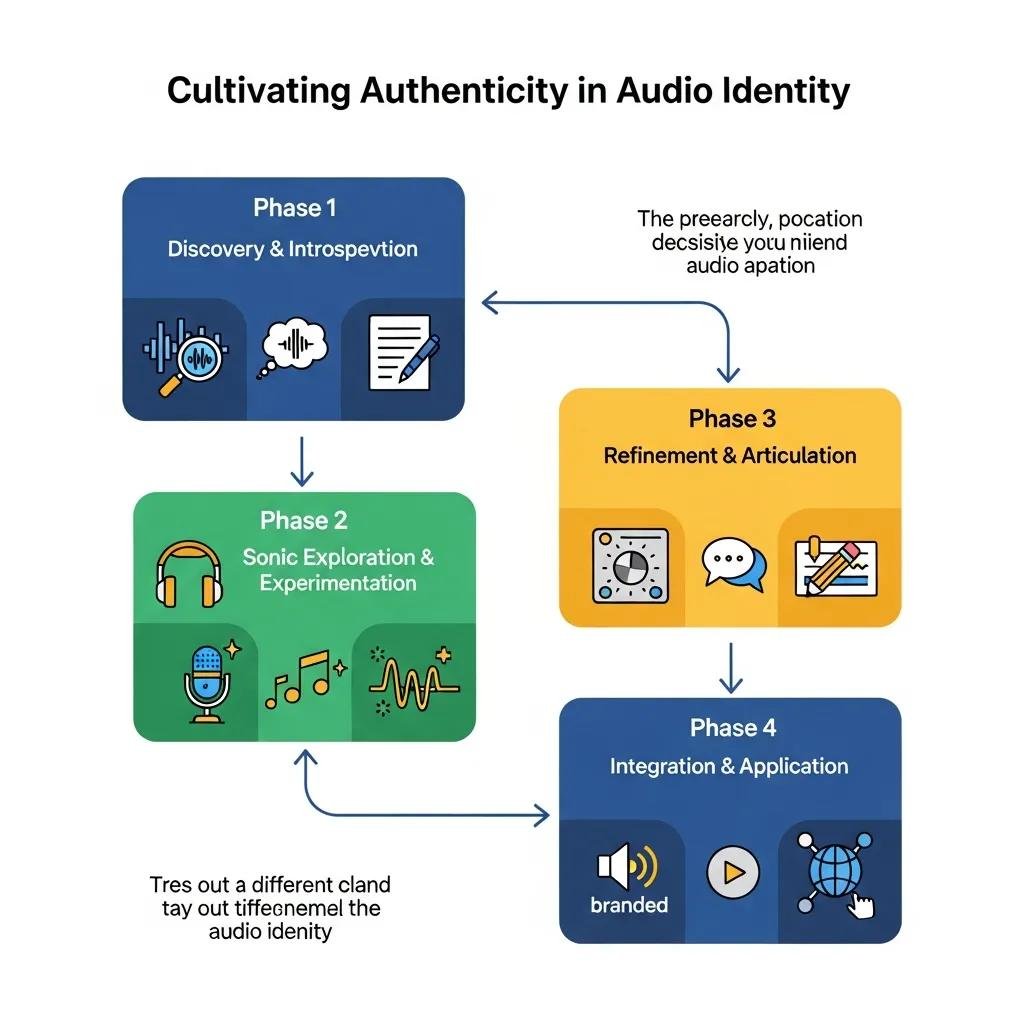
Cultivating authenticity follows a four-phase workflow: discovery to align sound with brand DNA, iterative creation with human artists, channel-ready implementation, and governance to maintain consistency and adapt over time. In discovery, gather brand attributes, audience profiles, and competitor audio cues to build a sonic brief that states desired traits and banned approaches. Creation pairs composers, lyricists, vocal talent, and producers to craft motifs, jingles, and voice samples with multiple test cuts and audience feedback loops. Implementation adapts assets to channel constraints—shorter ad mixes, stemmed files for apps, and clean voiceover stems for IVR—accompanied by style guidelines and asset libraries. Governance defines ownership, approval workflows, and an audit schedule so authenticity endures as markets evolve.
Discovering Brand DNA and Audience Insights for Sound Alignment
Discovery transforms business attributes and audience insights into a targeted sonic brief by using interviews, workshops, and rapid listening tests to surface emotional priorities and taboo cues. Begin with stakeholder interviews that extract adjectives describing the desired brand voice and translate those adjectives into sonic references (e.g., “approachable” → warm midrange vocals, “innovative” → unexpected harmonic shifts). Run short audio A/B tests with representative listeners to validate whether proposed timbres and motifs match intended perceptions. The output is a focused sonic brief that includes core motifs, voice-casting notes, and production constraints to direct creative teams. This brief then guides the iterative creation phase, where assets are produced and refined.
For organizations that prefer external support, specialized providers can operationalize this workflow—mapping discovery to deliverables and handling the human creative collaboration needed for truly original jingles, slogans, and voiceover assets.
Creating and Implementing Authentic Audio Across Brand Touchpoints
Implementation requires adapting core assets for each touchpoint—ads, mobile apps, in-store soundscapes, phone systems—and providing clear versions, stems, and usage rules to maintain fidelity. For ads, create multiple-length edits and dynamic mixes optimized for platform loudness standards; for apps and product demos, provide stemmed files to prevent modifications from eroding interactive layering; for IVR and on-hold systems, deliver clean voiceover stems and looped motifs at appropriate lengths. Versioning should include stem naming conventions, suggested loudness targets, and acceptable effect chains to prevent modifications from eroding authenticity. A rollout checklist that sequences pilot release, audience monitoring, and full deployment helps teams monitor reception and iterate where necessary. These implementation practices naturally lead to methods for measuring whether the audio identity remains authentic in-market.
How Do You Measure and Maintain Authenticity in Your Sonic Branding?
Measuring authenticity focuses on recognition, emotional resonance, and behavioral outcomes using both qualitative and quantitative tools to connect audio performance to brand objectives. Key audio branding KPIs include recognition rate in audio-only tests, recall lift in ad studies, emotional resonance scores from short surveys, and conversion or engagement uplift tied to audio variants. Measurement methods range from blind audio recognition tasks and short associative surveys to A/B ad testing and longitudinal brand tracking that includes audio-specific questions. This section lays out KPIs, measurement methods, and an audit cadence to keep your sonic identity aligned with audience expectations over time.
Key Performance Indicators for Brand Audio Authenticity
Audio branding KPIs should capture awareness, emotional fit, and behavior, with clear measurement methods and targets that guide iteration. Typical KPIs include:
- Recognition Rate: Percentage of listeners who correctly identify the brand from an audio clip measured with controlled audio recognition tests.
- Recall Lift: Increase in unaided brand recall after exposure, measured in ad testing panels.
- Emotional Resonance Score: Self-reported emotional alignment measured via short surveys linking descriptors to audio stimuli.
- Conversion Uplift: Behavioral changes attributable to audio variants measured through A/B testing and tracking.
Set realistic targets based on baseline studies, then use a combination of controlled lab tests and in-market A/B experiments to attribute outcomes to audio changes. Interpreting these metrics feeds governance decisions about whether to refresh motifs, re-record voiceovers, or adjust production style.
Strategies for Continuous Auditing and Adaptation of Audio Identity
Maintaining authenticity requires a lightweight audit cadence, clear stakeholder roles, and micro-testing frameworks that allow incremental adaptation without losing core identity. Recommend quarterly micro-audits that re-run recognition and emotional tests for high-use assets and annual comprehensive audits covering all channels. Define roles: creative owner for asset integrity, measurement owner for KPI tracking, and governance lead for approvals and version control. Use micro A/B tests (small sample sizes, focused hypotheses) to test slight production adjustments—such as alternate vocal deliveries or instrumentation swaps—and scale changes only if metrics improve. Preserve core motifs and lyrical truths during updates to maintain continuity while allowing tactical evolutions that respond to audience feedback.
Intro paragraph: The list below outlines an audit and testing cadence to maintain authenticity.
List of audit actions:
- Run quarterly recognition and emotional resonance checks on primary motifs.
- Use micro A/B tests before broad re-recordings to validate changes.
- Keep a version-controlled asset library with change logs and approvals.
- Involve cross-functional stakeholders in annual reviews to align brand evolution.
What Are the Future Trends Impacting Authentic Sound Branding in 2025?
In 2025, three trends reshape how brands maintain authenticity: hybrid AI-human workflows, immersive spatial audio experiences, and hyper-personalized short-form audio for social platforms. AI tools accelerate ideation, generate safe variations, and handle routine editing tasks, but human composers and vocalists remain essential for lyric truth, emotional nuance, and final approval. Immersive audio—spatial mixes and object-based formats—creates richer engagement opportunities, especially for AR/VR experiences and in-store environments. Still, designers must maintain authentic motifs and avoid novelty for novelty’s sake. Short-form platforms reward instantly recognizable motifs and human-led voice moments that cut through algorithmic noise. These trends suggest practical hybrid models that preserve authenticity while leveraging new capabilities.
Balancing AI Integration with the Human Touch in Audio Creation
AI can assist with time-consuming tasks—draft motif ideas, generate alternate arrangements, and perform mix recalls—while human artists focus on lyric relevance, vocal expression, and cultural nuance that preserve authenticity. A hybrid workflow uses AI for iteration and efficiency, while maintaining human oversight for final composition, lyric approval, and voice casting to ensure emotional fidelity. Governance safeguards should require human sign-off on any AI-generated lyrics or vocal models and mandate traceable provenance for audio assets to maintain originality and avoid genericization. Validation checks, such as blind emotional resonance tests and manual lyrical review, help confirm that the result retains a human feel and aligns with brand truth.
Leveraging Immersive Audio Experiences for Deeper Brand Engagement
Immersive audio offers new ways to deepen engagement by placing listeners inside a branded soundscape that communicates context, texture, and personality beyond a single motif. Use spatial audio for product demos, AR overlays, or in-store atmospheres to create memorable, congruent experiences that reinforce your sonic identity; however, maintain core motifs and lyrical anchors so listeners retain brand recognition across immersive and non-immersive contexts. Technical considerations include delivering multichannel stems, ensuring compatibility with target playback devices, and testing for accessibility and comfort. Measurement of immersive experiences should blend UX metrics with audio recognition and emotional response to ensure these formats enhance rather than dilute authenticity.
Final integration paragraph (call-to-action embedded naturally)
For teams exploring next steps, consider commissioning an authenticity audit or custom assets—such as an original sonic logo, lyric-based jingle, or a consistent voiceover suite—so your audio identity starts with a discovered brand brief and ends with governed, channel-ready assets. Sound Branding Ideas provides specialized creative services and end-to-end workflows to translate discovery into original audio assets with the human nuance required for trustworthy sonic identity. If you want help mapping a discovery process to deliverables or producing custom jingles and voiceovers that preserve authenticity, consulting with experienced audio branding specialists can accelerate your ability to achieve what you want: effective, measurable outcomes.
Frequently Asked Questions
What are the key benefits of having an authentic audio identity for a brand?
An authentic audio identity enhances brand recognition and fosters emotional connections with the audience. By using unique sonic elements that reflect the brand’s values, companies can create a memorable experience that resonates with listeners. This emotional resonance leads to increased trust and loyalty, as consumers are more likely to engage with brands that feel genuine. Additionally, an authentic audio identity can differentiate a brand in a crowded market, making it easier for consumers to recall and prefer it over competitors.
How can brands test the effectiveness of their audio branding?
Brands can test the effectiveness of their audio branding through methods such as blind audio recognition tests, A/B testing, and emotional resonance surveys. These tests help measure how well audiences recognize and recall audio elements, as well as their emotional responses to them. By analyzing metrics such as recognition rates and recall lifts, brands can gain insights into how their audio identity shapes consumer perceptions and behaviors, enabling informed adjustments to enhance authenticity and effectiveness.
What role does audience feedback play in developing a brand’s audio identity?
Audience feedback is crucial in developing a brand’s audio identity as it provides insights into how target consumers perceive and connect with audio elements. Engaging with listeners through surveys, focus groups, or testing sessions allows brands to understand emotional responses and preferences. This feedback can guide the refinement of sonic motifs, jingles, and voiceovers, ensuring that the final audio identity resonates authentically with the audience. Incorporating audience insights helps brands create a sound that aligns with consumer expectations and enhances overall engagement.
How can brands ensure consistency in their audio identity across different channels?
To ensure consistency in their audio identity across channels, brands should develop a comprehensive style guide outlining approved sonic elements, including motifs, voiceovers, and production styles. This guide should include specifications for different platforms, such as ads, social media, and in-store experiences. Additionally, maintaining a centralized asset library with version-controlled audio files enables teams to access the correct materials easily. Regular audits and cross-functional collaboration can further help uphold consistency and adapt the audio identity as needed while preserving its core elements.
What are some common pitfalls to avoid when creating an authentic audio identity?
Common pitfalls in creating an authentic audio identity include relying too heavily on generic or overly polished audio that lacks personality, which can dilute brand authenticity. Additionally, neglecting to align audio elements with the brand’s core values and audience expectations can lead to disconnection. Brands should also avoid using stock sounds that do not reflect their unique identity. Lastly, failing to test and iterate on audience feedback can result in an audio identity that fails to resonate, ultimately undermining trust and recognition.
How can brands adapt their audio identity to changing market trends?
Brands can adapt their audio identity to changing market trends by conducting regular audits and staying informed about emerging audio technologies and consumer preferences. Implementing a flexible governance framework allows for incremental updates to audio elements while preserving core motifs. Engaging in continuous audience testing and feedback loops can help identify shifts in listener expectations. Additionally, exploring innovative formats, such as immersive audio experiences, can enhance engagement and ensure that the brand remains relevant and resonant in a dynamic market landscape.
Conclusion
Establishing an authentic audio identity is essential for building trust and emotional connections with your audience. By aligning sonic elements with your brand values, you can create a memorable experience that enhances recognition and loyalty. To take the next step in cultivating your brand’s unique sound, consider exploring our specialized services for custom audio assets. We want to help you transform your audio identity into a powerful tool for engagement and differentiation.